
Blog
Paraffin vs. Soy Candles: What Does Science Really Say?
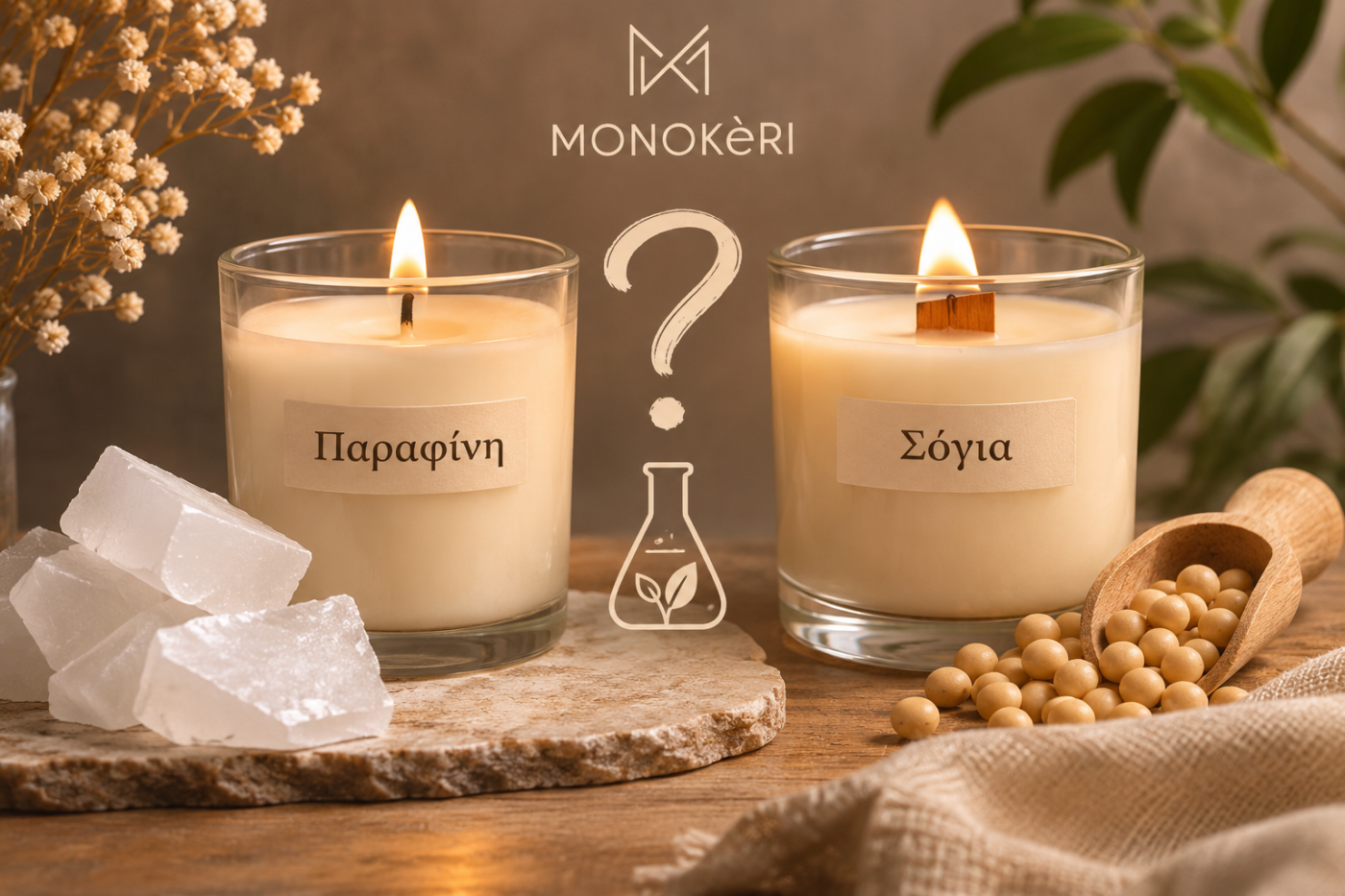
In recent years, phrases such as "natural candle", "plant-based candle", "clean burn" and "paraffin-free" have been circulating constantly in the scented candle market. Paraffin is often presented as an undesirable ingredient and soy as the obviously safer choice. So what does science really say?
International research shows that a candle's emissions depend on many things together: its composition, the wick, the fragrance, the quality of the materials, the behaviour of the flame and the way it's used. It's worth looking at what the data show, beyond the marketing messages.
What is paraffin and why is it used in candles?
Paraffin is a mixture of hydrocarbons produced mainly during the processing of petroleum. It has been used in candle-making for decades because it melts and solidifies easily and burns steadily. Its quality and degree of processing matter.
Soy candles are made from processed soybean oil, while candle-making also uses rapeseed waxes, palm, beeswax and combinations of different raw materials. The origin can have environmental significance, but on its own it isn't enough to predict the emissions of the finished candle.
Do paraffin candles produce dangerous substances?
Every lit candle is a combustion process. Both paraffin candles and plant-based candles can produce gases, volatile organic compounds and airborne particles. What matters isn't only whether a substance is detected, but how much is produced, for how long and under what exposure conditions.
A 2021 study in Environment International , 24 experiments with scented and unscented candles were examined. Among other things, formaldehyde, benzene, nitrogen oxides and particles were measured. In most of the modelled exposure scenarios the concentrations were lower than the relevant reference values. Exceptions were identified for specific pollutants, however, such as nitrogen dioxide, acrolein and benzo[a]pyrene.
The results, then, don't mean that every candle is harmless or that none produces pollutants. They mean that assessment needs measurements and specific usage scenarios.
Research source: Salthammer, T. et al. (2021), Measurement and evaluation of gaseous and particulate emissions from burning scented and unscented candles. Read the study in Environment International.
Are soy candles always cleaner?
The claim that plant-based candles necessarily burn cleaner than paraffin candles isn't supported, as an absolute rule, by the scientific literature.
A 2026 study in Atmosphere compared six commercial candles, three paraffin, two soy and one beeswax, in a closed room without ventilation. The naturally sourced candles in the test showed larger numbers of ultrafine particles, while the paraffin candles showed higher concentrations of larger particles in the 0.3–10 μm range. The differences in volatile organic compounds were not statistically significant.
The word "natural", then, doesn't prove lower emissions on its own. The study included only six candles with different characteristics, though, so it doesn't show a general superiority of paraffin either. It shows that it's worth judging the actual finished products and not their label.
Research source: Crunkelton, D. et al. (2026), Emission Characterization of Synthetic and Natural Candles in a Residential Environment. Read the full study in Atmosphere.
Why the quality of paraffin matters
Paraffin isn't a single, uniform raw material. Its composition, purity and characteristics can affect how the candle behaves while burning.
Derudi and his colleagues examined pollutant emissions from candles of different composition, including volatile organic compounds and polycyclic aromatic hydrocarbons. The conclusion is that assessment can't be limited to a label such as "paraffin" or "soy". What matters is the quality of the materials and the performance of the finished candle.
Research source: Derudi, M. et al. (2014), Emission of air pollutants from burning candles with different composition in indoor environments. Read the study in Environmental Science and Pollution Research.
What does research show about human health?
A 2014 study in Regulatory Toxicology and Pharmacology evaluated emission measurements from scented candles and calculated consumer exposure scenarios. It did not identify known health risks under the usual conditions it examined.
The finding has limits: it isn't a guarantee of safety for every candle, every fragrance and every indoor space. In addition, the research was funded by and involved industry bodies, which is worth bearing in mind when reading it critically.
Research source: Petry, T. et al. (2014), Human health risk evaluation of selected VOC, SVOC and particulate emissions from scented candles. Read the scientific publication.
The role of the wick and correct burning
The wick, its dimensions and its compatibility with the wax blend affect the behaviour of the flame. A wooden wick can offer a distinctive aesthetic experience, but it doesn't automatically guarantee lower emissions than any cotton one.
In Europe, the standard EN 15426:2018 addresses the sooting behaviour of candles. See the details of EN 15426:2018.
Whichever candle you choose, the manufacturer's instructions matter: make sure the room is ventilated, trim the wick as recommended and never leave a lit candle unattended.
Natural doesn't automatically mean safer, and synthetic doesn't automatically mean dangerous
It's very common to associate the word "natural" with safety and the word "synthetic" with something harmful. In science, though, the origin of a substance isn't enough to judge whether it's safe or dangerous.
A substance of plant origin can produce unwanted emissions when burned, just like a substance of mineral origin. Likewise, the fact that paraffin comes from processing petroleum doesn't automatically mean that every candle containing it is dangerous to health.
An assessment considers the quality of the raw materials, the formulation of the finished candle, the substances released during burning and the conditions of exposure.
Safety depends on the material’s actual properties and the available scientific evidence.
Are soy candles more eco-friendly than paraffin candles?
The term "eco-friendly" doesn't concern only what a candle emits when it burns. It also includes the environmental footprint over its entire life cycle: raw material production, land use, energy, transport and final disposal. For example, soy is a renewable plant raw material, but the expansion of its cultivation has been linked in some parts of South America to deforestation and the conversion of natural ecosystems. study in Nature Sustainability found that the area planted with soy in South America more than doubled between 2000 and 2019. The researchers also highlighted indirect pressure through the displacement of pasture. The origins and traceability of the soy used in a given candle matter.
On the other hand, paraffin comes from non-renewable petroleum, but it can be produced from waxy fractions separated during refining, especially in the production of lubricating oils. As explained by the Pennsylvania State University, a material called slack wax is a feedstock for making paraffin. Using this refinery stream does not establish that it would otherwise go to waste, nor does it eliminate the environmental impacts of the petroleum chain and the fossil CO₂ released by burning.
The environmental comparison, then, isn't black and white. A plant-based candle has a renewable raw material but can be burdened by cultivation and land-use changes; a paraffin candle can make use of refinery material, but remains a product of fossil origin. life cycle study in Green Chemistry showed that alternative waxes of biological origin can have a smaller or larger climate footprint than paraffin, depending on the raw materials and the assumptions of the analysis; the study is not a direct ranking of soy and paraffin candles. For a reliable assessment you need origin data and life cycle assessment of the finished product, rather than general claims about natural or synthetic materials.
Frequently asked questions
Are paraffin candles dangerous?
Wax type alone cannot establish whether a candle poses a risk. Exposure depends on the candle and the conditions in which it is burned.
Are soy candles always better?
The emissions evidence varies by candle and pollutant. Some plant-wax candles produced more ultrafine particles than the paraffin candles tested in one small study.
Which candles produce less soot?
The raw material alone isn't enough as a criterion. Suitable tests of the finished candle are needed, since the wick, the composition and the flame affect the result.
What the evidence supports
Studies offer useful comparisons within defined conditions. There isn't enough data to consider every paraffin candle dangerous or every plant-based candle automatically safer. Material quality, formulation, wick design, combustion conditions and care all play a role.
Use those details to make an informed choice.
Research references
EN 15426:2018 — Candles: Specification for sooting behaviour.
Safe Candle Burning Guidelines
